The Syncwire USB C Car Charger pairs a compact metal body with USB-C PD and USB-A QC 3.0 ports, making it a practical option for keeping a phone powered on the road.
This Syncwire USB C Car Charger for iPhone review looks at its charging setup, fit, and the limits to consider when powering two devices.
Syncwire Car Charger Review Summary
The quick verdict
14,000+ ratings
Read Amazon ReviewsSyncwire USB C Car Charger
A good fit for iPhone and Android drivers who want a discreet, metal dual-port charger for everyday commutes and road trips.
- Two charging ports: USB-C with PD 3.0 up to 30W and USB-A with QC 3.0 up to 30W; the combined output is up to 60W.
- Supports simultaneous charging of two devices, with the caveat that both ports do not provide simultaneous super-fast charging.
- Compact all-metal housing designed to sit nearly flush in a standard vehicle socket.
- Compatible with standard auto sockets using 12–24V input.

Pros
- Combines USB-C PD and USB-A QC charging in one small adapter.
- Low-profile form is well suited to a crowded console or a socket near other controls.
Consider before buying
- Two devices can charge at once, but simultaneous use does not maintain the maximum fast-charging capability on both ports.
- The adapter provides charging ports rather than an integrated cable, so buyers need suitable cables for their devices.
Read the full review summary
This charger is designed for drivers who want fast-charging options without a bulky adapter protruding from the console.
Its USB-C PD 3.0 port supports up to 30W, while the USB-A QC 3.0 port supports up to 30W; together, the unit is rated for up to 60W.
The product description lists iPhone, Samsung, Pixel, iPad, and other device families, giving it broader appeal than an iPhone-only charger.
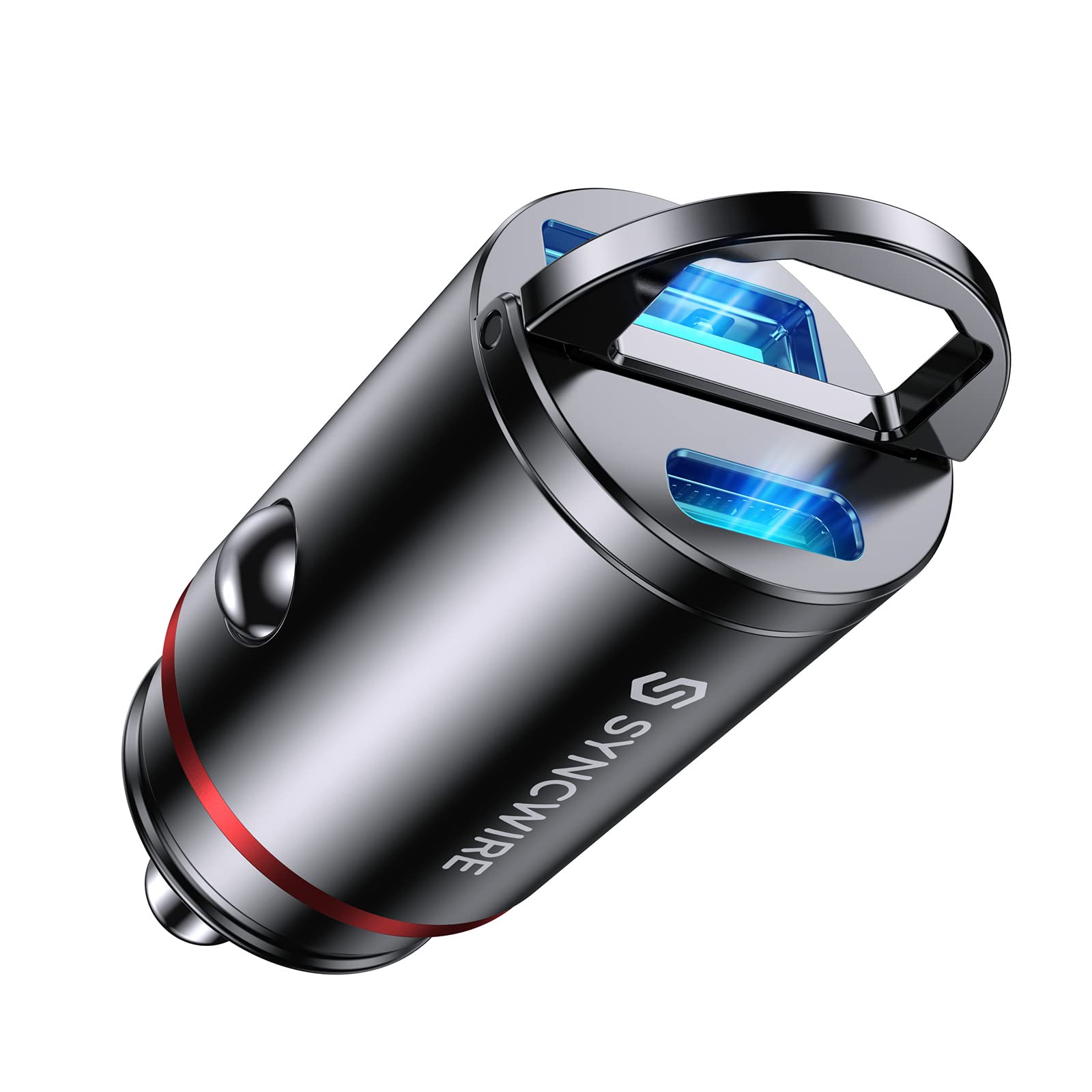
The small all-metal adapter is intended to sit nearly flush in a 12–24V vehicle socket. A pull ring helps remove it, and a blue LED can make the ports easier to locate in low light.
It can charge two devices at once, but simultaneous charging does not provide each port’s maximum fast-charging capability. Buyers should also confirm that their device and cable support the charging standard they intend to use.
The buying factors
Syncwire Car Charger Scorecard
Editorial scores reflect listed features and buyer fit; they are not laboratory measurements or customer ratings.
Charging flexibility
USB-C PD 3.0 and USB-A QC 3.0 cover two commonly used charging approaches, with up to 30W available per port.
Two-device use
It can charge two devices simultaneously, though the description cautions that both cannot receive super-fast charging at once.
Console footprint
The thumb-sized metal body is designed to sit flush and take up little space around the socket.
Vehicle compatibility
Its stated 12–24V input suits standard vehicle sockets across a broad range of cars and other vehicles.
Device range
The listed compatibility includes iPhone, Samsung, Pixel, iPad, and more, across PD and QC charging standards.
Removal and visibility
A foldable pull ring aids removal, and the soft blue LED helps locate the ports in darkness.
Key Features and Specifications of Syncwire Car Charger
- Two charging ports: USB-C with PD 3.0 up to 30W and USB-A with QC 3.0 up to 30W; the combined output is up to 60W.
- Supports simultaneous charging of two devices, with the caveat that both ports do not provide simultaneous super-fast charging.
- Compact all-metal housing designed to sit nearly flush in a standard vehicle socket.
- Compatible with standard auto sockets using 12–24V input.
- Pop-up pull ring and foldable handle make the small adapter easier to remove.
- Soft blue LED light helps identify the ports in low-light conditions.
- Listed compatibility includes iPhone, Samsung Galaxy, Google Pixel, iPad, and other devices using supported charging standards.
Pros and Cons of Syncwire Car Charger
Pros
- Combines USB-C PD and USB-A QC charging in one small adapter.
- Low-profile form is well suited to a crowded console or a socket near other controls.
- Pull ring gives a clear way to remove the adapter despite its compact shape.
- Broad listed compatibility suits households with a mix of phones and tablets.
Consider before buying
- Two devices can charge at once, but simultaneous use does not maintain the maximum fast-charging capability on both ports.
- The adapter provides charging ports rather than an integrated cable, so buyers need suitable cables for their devices.
- Its nearly flush design may be harder to grasp than a larger adapter; consider whether the pull ring is accessible in your vehicle’s socket location.
Who Should Buy Syncwire Car Charger?
Good fit
Consider the Syncwire if you want a small charger that keeps the socket area tidy while offering a USB-C PD port for a compatible iPhone or tablet and a USB-A QC port for another device.
The stated 12–24V input and compatibility across several phone families make it suitable for drivers whose passengers may use different brands.
It also makes sense when you want a charger that can remain installed without sticking far out from the console.
The pull ring is a useful detail for anyone who removes the adapter between drives, while the blue LED can help find the ports at night.
Before buying, match the port to your device’s charging support and choose the appropriate cable.
If two devices will be connected together, plan around the stated limitation: simultaneous charging is supported, but both ports will not deliver super-fast charging at the same time.
Who should skip it
Look elsewhere if your main goal is to fast-charge two devices at their maximum rates simultaneously; this model explicitly does not offer that behavior.
This is also a poor fit if you need the charger itself to include a built-in cable. Check your vehicle’s socket placement and available grip space if a flush-mounted adapter would be difficult for you to reach.
How the Syncwire Car Charger Fits Everyday Driving
A useful split between USB-C and USB-A
The two ports let the charger serve devices that use different charging standards.
USB-C PD 3.0 is the relevant connection for compatible iPhones and many newer devices, while USB-A QC 3.0 can serve compatible Android phones and other USB-powered gear.
The maximum output figures describe the ports’ capabilities; the device and cable also need to support the chosen standard for fast charging to apply.
Know what changes when both ports are occupied
The charger can power two devices at the same time, which is useful for a driver and passenger or a phone alongside another small device.
Its stated limitation matters for road trips: connecting a second device does not preserve super-fast charging on both ports. If quick top-ups are the priority, using one port at a time may better match the intended use.
Low profile, with removal in mind
A small adapter that sits nearly flush can leave more room around nearby controls and reduce visual clutter.
That same compact shape can give fingers less surface to grasp, so the foldable pull ring has a practical role beyond appearance.
Its usefulness will depend on whether the ring is accessible once the charger is installed in your vehicle.
A fit for standard 12–24V sockets
The stated input range covers standard vehicle sockets in cars and other vehicles that provide 12–24V. Since the design depends on a cigarette-lighter-style power socket, check what kind of outlet is available in your vehicle before choosing it.
The blue LED is a small convenience for locating the ports in the dark, while the charger’s primary job remains wired USB charging.
Alternatives to Syncwire Car Charger
Cell Phone Automobile Chargers alternative
200+ ratings
Read Amazon ReviewsSyncwire 54W Dual-Port USB-C Car Charger
Choose the main model if a higher stated USB-A output and nearly flush footprint matter most.
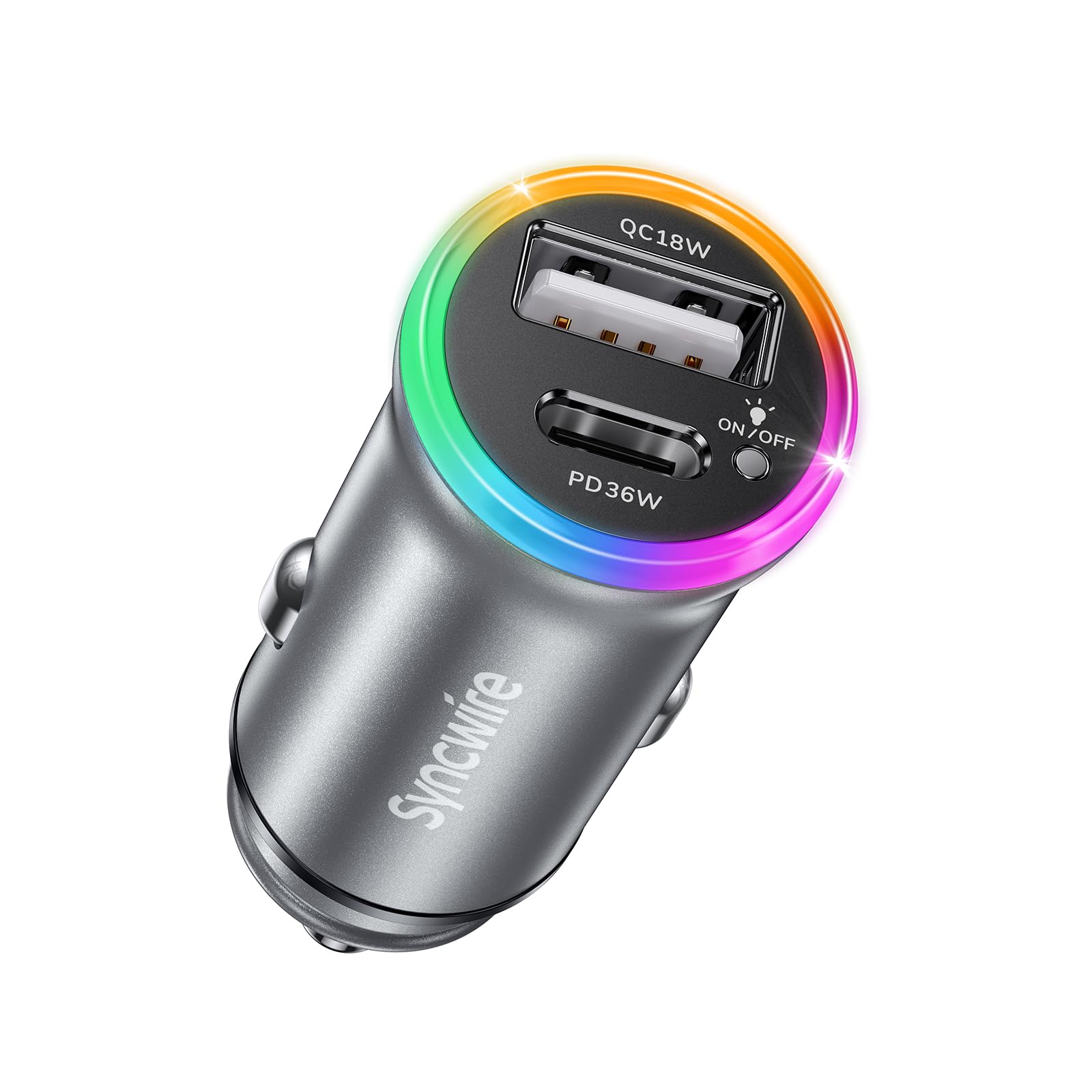
Consider this alternative if selectable lighting and its stated simultaneous port behavior better suit your setup, while noting the different per-port output ratings.
- This other Syncwire model lists a USB-C PD port up to 36W and a USB-A QC port up to 18W, with simultaneous use described as operating without reducing power.
- It also has touch-controlled, selectable LED light modes.
- The main Syncwire offers a low-profile metal body, with USB-C PD and USB-A QC ports rated up to 30W each, and does not provide simultaneous super-fast charging on both ports.
Cell Phone Automobile Chargers alternative
500+ ratings
Read Amazon ReviewsBESTEK 125W Six-Port Car Charger
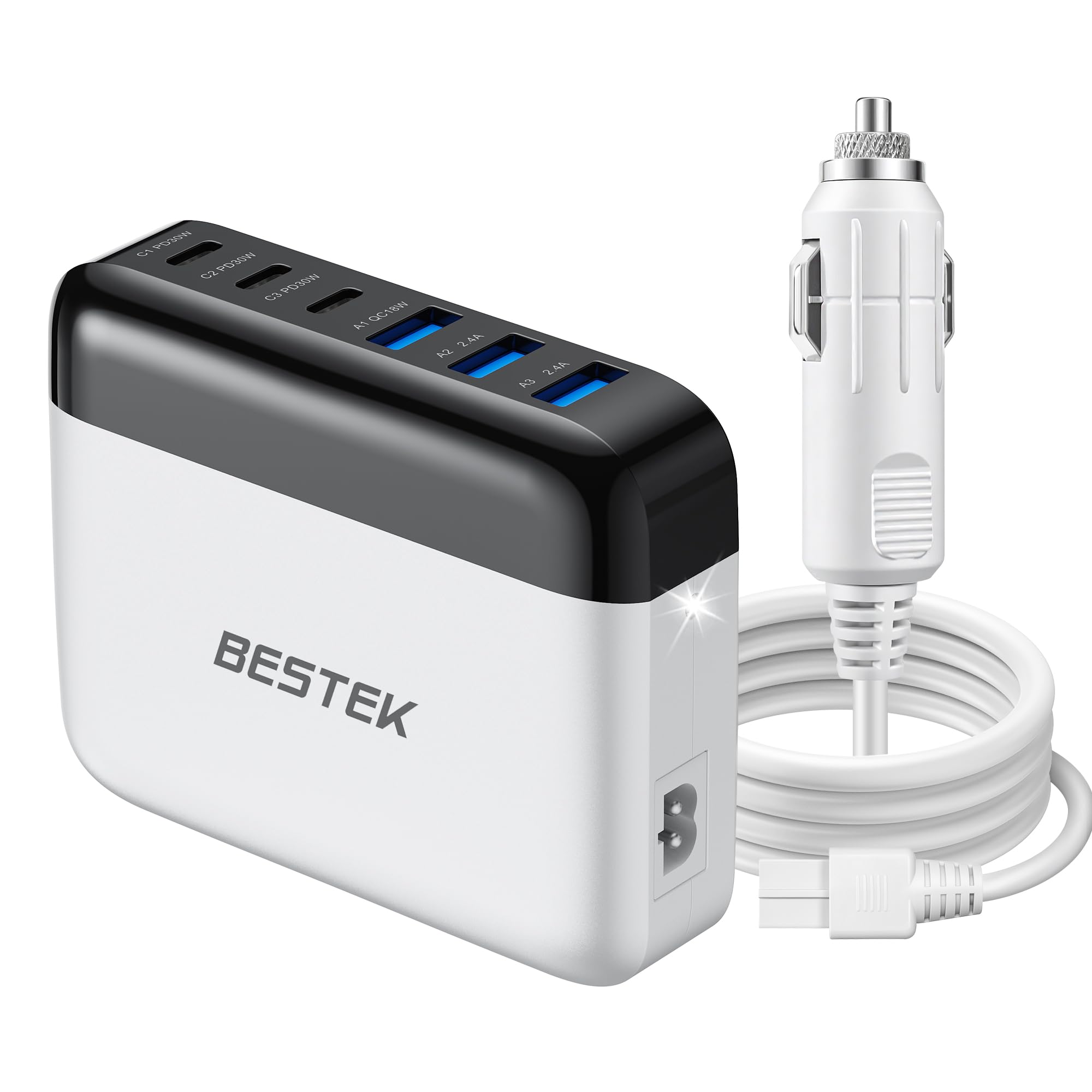
Pick the Syncwire for a minimal console setup with two charging connections. The BESTEK is the more suitable choice when several occupants or devices need ports at once and a larger multi-port charger better fits the vehicle.
- The BESTEK uses a six-port design: three USB-C PD ports rated at 30W each, one QC 3.0 port rated at 18W, and two additional 2.4A ports.
- It is designed to charge up to six devices simultaneously and supports 12–24V vehicle input.
- The main Syncwire is a thumb-sized two-port adapter aimed at a discreet setup, with a specific caveat about simultaneous super-fast charging.
Is Syncwire Car Charger Worth It?
The Syncwire USB C Car Charger is worth considering if you want a compact, low-profile way to add USB-C PD and USB-A QC charging to a standard vehicle socket.
Its broad listed compatibility, pull ring, and two-port layout make it a practical choice for everyday drives.
Buy it with the simultaneous-charging limit in mind: two devices can connect, but both will not receive super-fast charging at once.
Confirm your vehicle has a suitable 12–24V socket and that you have the right cables and charging support for your devices.
Your review at a glance
14,000+ ratings
Read Amazon ReviewsSyncwire USB C Car Charger
A good fit for iPhone and Android drivers who want a discreet, metal dual-port charger for everyday commutes and road trips.
- Two charging ports: USB-C with PD 3.0 up to 30W and USB-A with QC 3.0 up to 30W; the combined output is up to 60W.
- Supports simultaneous charging of two devices, with the caveat that both ports do not provide simultaneous super-fast charging.
- Compact all-metal housing designed to sit nearly flush in a standard vehicle socket.
- Compatible with standard auto sockets using 12–24V input.